How Shapewiz works out a size.
You’re trusting us with your customers’ sizes. Here is exactly what happens, with the sources and the limits.
1. From height and weight to a body
People of the same height and weight differ, but not at random. Shapewiz’s body model, ShapeModel™, estimates a shopper’s bust or chest, under-bust, waist, hips, shoulders and inside leg from height, weight and, if given, age. It also estimates how far off each number is likely to be.
The model was fitted person by person on 23,059 adults measured with a tape by trained measurers:
| Survey | People | What it gives us |
|---|---|---|
| ANSUR II, US Army, 2012 | 6,066 | Bust and chest, shoulders, inside leg, and how body areas move together |
| ANSUR I, US Army, 1988 | 3,982 | The natural waist (the “waist” on most charts) and under-bust |
| NHANES, US national health survey, 2017–2023 | 13,011 | Waist and hips of the general public, ages 18 to 75 |
Then it was checked, and adjusted where needed, against published averages from about 48,000 more people:
| Survey | People | What it tells us |
|---|---|---|
| Health Survey for England, 2019, 2022, 2024 | 12,501 | UK shoppers match the model, so nothing changes for them |
| Health Survey for England 2004, minority ethnic groups | 12,623 | The South Asian waist pattern |
| WHO STEPS Pakistan, 2013–14 | 6,600 | Confirms the Pakistan adjustment |
| WHO STEPS Qatar, Kuwait and Saudi Arabia; Qatar Biobank | 16,148 | The shared Gulf adjustment |
How close is the estimate? On people the model never saw, from height, weight and age alone, it is typically off by about 1 cm at the shoulders, 2 cm at the inside leg, 2 to 3.5 cm at the bust, chest and hips, and 2.5 to 4.5 cm at the waist. The shopper’s own answers narrow that.
2. The shopper corrects it
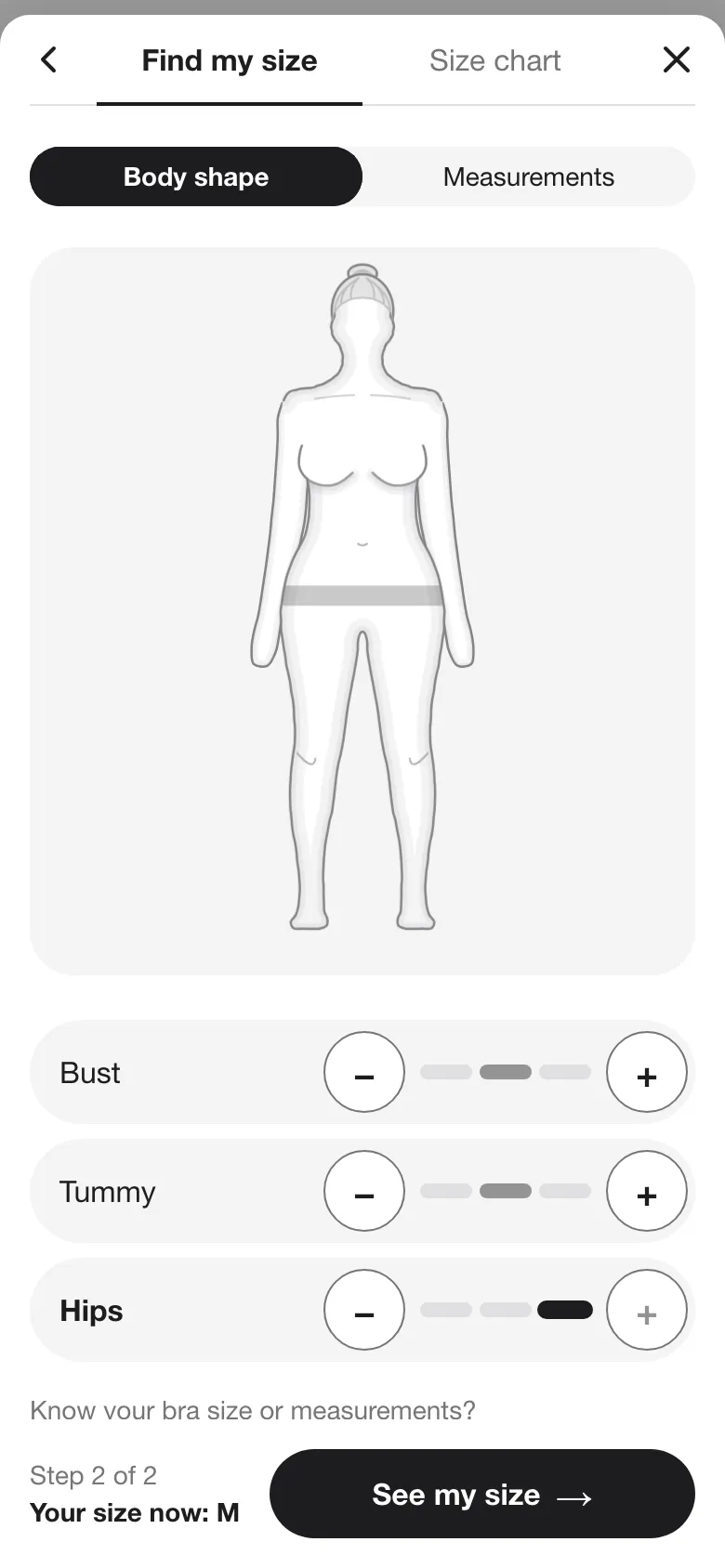
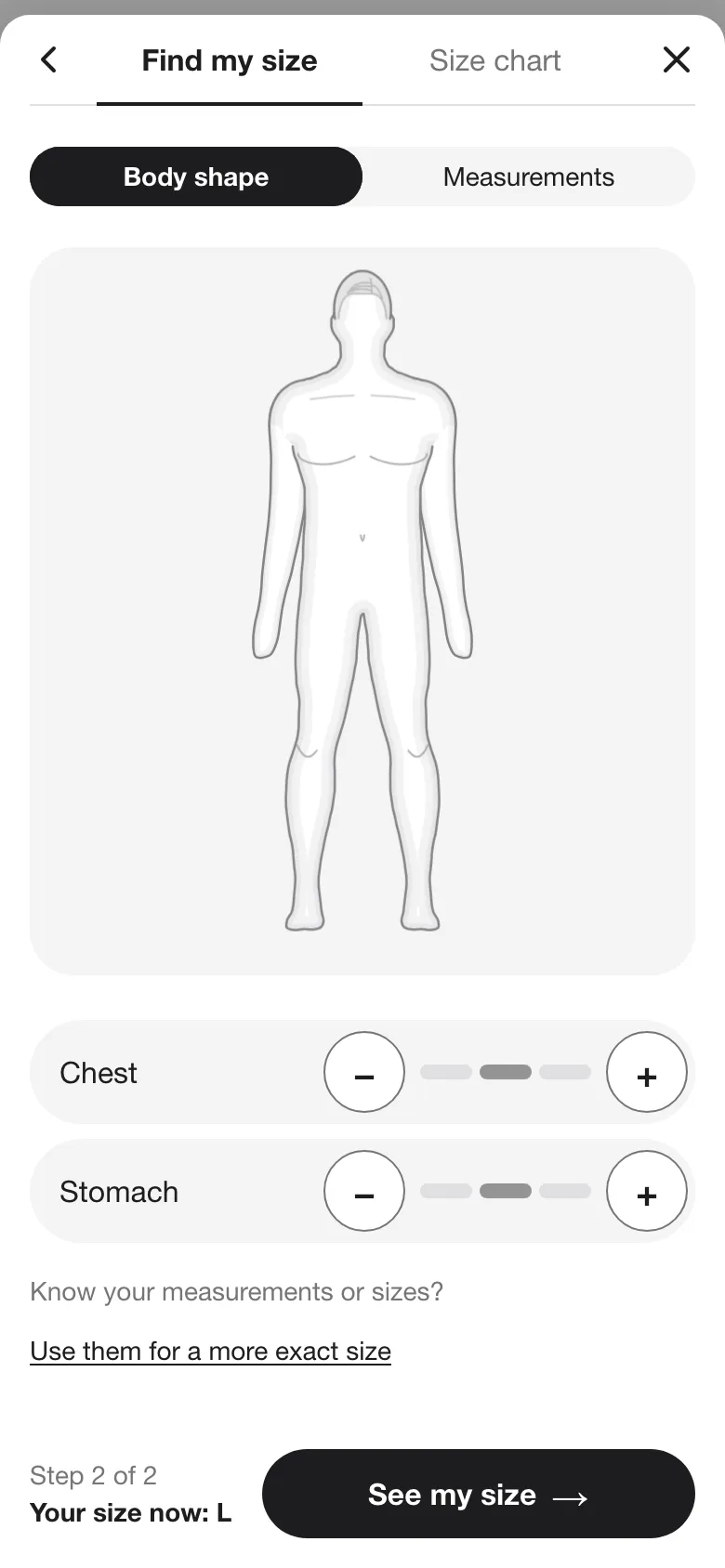
The figure in step 2 shows what the model thinks. “Not sure” keeps our estimate. Each − or + moves that area by about half the normal spread between people of that height and weight. The connected areas move a little too, the way real bodies do.
A bra size gives the bust and under-bust directly. A typed measurement replaces our estimate for that area. Men can give a trouser size and a jacket size. Each is read as a tailor would read it and blended with the estimate, since a label is less exact than a tape.
3. Where the shopper lives
At the same height, weight and age, shoppers in Pakistan carry 1 to 1.5 cm more at the natural waist than the model’s average, and Gulf men about 2 cm more at the hips. Shapewiz picks the adjustment from where the shopper is shopping from, and falls back to your store’s country. You set nothing. Where surveys don’t agree, we leave the model alone.
4. The figure
The figure is drawn from open 3D human bodies (Anny, by NAVER LABS, built on MakeHuman’s open data), each fitted so its height, weight, bust or chest, waist and hips match our model. It’s a drawing, not a scan: no face, no clothes, no photo of anyone. It is never mirrored in Arabic.
5. Matching your chart
Your chart decides the size, not ours. We read each column as a measuring point, know whether the chart measures the body or the garment, double flat widths, and allow the room each garment type is meant to have. A ribbed hem is never compared with the body. If you mark a product as running small, we allow for it and tell the shopper.
The finder only asks about areas your chart measures, and only names sizes the product sells.
6. How sure we are
We don’t take one guess. We look at all the bodies that fit these answers and count how many fit each size. When most land on one size, it’s a Strong match. When they split, it’s a Likely match, and we name the other size. Without a weight, it’s a Rough guess, and we say so.
7. What stays private
Answers stay in the shopper’s browser, so the next product shows their size straight away. No names, no emails, no account, no photos. “Delete my answers” removes them. Read security and privacy.
8. What it doesn’t do
- It doesn’t take photos or scan anyone.
- It doesn’t put clothes on the figure.
- It can’t fix a chart with wrong numbers, so check yours with Test this chart before it goes live.
- The model rests mostly on US measurements. The regional checks adjust it only where surveys agree.
- People often type a slightly taller height and lighter weight than they are. That can push a size a little small.
- The size finder is for adults. Kids’ charts show as a chart only.